
Multiply the carrier’s actual day-pass charge by the number of chargeable days, then compare it with the eSIM checkout price plus taxes, extra top-ups and any calling requirements. The answer depends on real quotes, not an invented average.
Write down both complete offers
A carrier may bill a day pass whenever qualifying usage occurs, with rules for cut-off time and included minutes. A travel eSIM may charge once for fixed data but exclude SMS and voice. You cannot compare them honestly until you record these differences. Use the total you would actually pay, including taxes and any currency conversion fees.
Illustrative example, not a market price
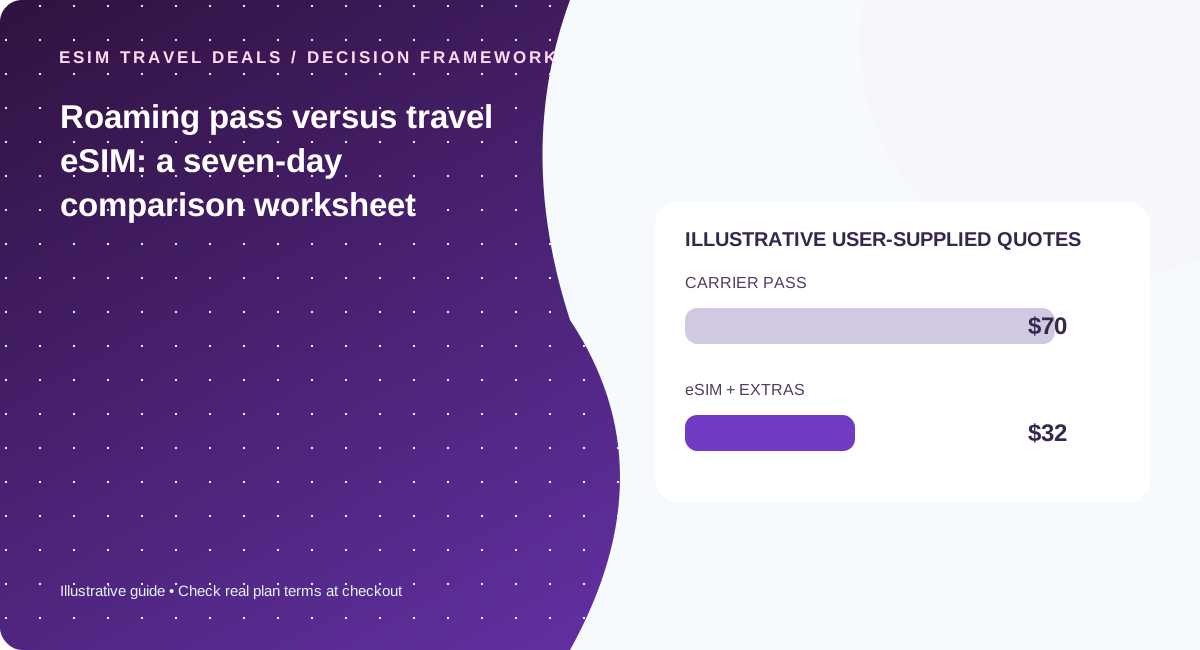
Assume your own carrier quotes a $10 daily charge for seven chargeable days; the hypothetical carrier total is $70. If a compatible eSIM checkout quotes $24 and you expect $8 in extra data, the hypothetical eSIM total is $32. The $38 difference is arithmetic on your inputs, not a promise that any brand currently sells that product for $24.
Price the missing services
If you need to receive conventional mobile calls or SMS, check whether keeping your home SIM active creates extra charges; a data-only eSIM will not automatically include them. Compare connectivity reliability and plan coverage as eligibility conditions before choosing the cheapest number.
Calculate the break-even point
Divide the total travel-eSIM cost by the carrier’s eligible daily-pass fee to estimate the number of chargeable days at which the eSIM becomes cheaper. If the carrier offers included roaming, a family bundle, fair-use eligibility or a weekly cap, redo the calculation using those actual terms.
Walk through the arithmetic carefully
Take two hypothetical inputs: a carrier day-pass charge of $10 per chargeable day and a seven-day trip. Multiplication gives $70 if every day triggers the pass. Then take a hypothetical travel eSIM checkout of $22, an expected $5 top-up and $4 in taxes or transaction charges, giving a $31 total. Under these assumptions the difference is $39. This is not a real competitor price comparison or guaranteed saving; different pass triggers, taxes, data allowances, calling benefits and coverage can reverse the conclusion. The useful calculation is repeatable: write down the exact carrier day-pass rule, which days count, the real eSIM payable total and any services you will have to buy separately. Keep all monetary values in the same currency and check foreign transaction fees on the payment method if they apply.
The first question is eligibility, not price
An offer only belongs in the calculation if it covers the whole itinerary and supports the device. A seven-day pass might include your conventional calls or SMS, while an apparently cheaper travel eSIM may be data-only. If you need authentication texts, business calls or laptop hotspot, note their separate costs or restrictions. EU residents could already have regulated roaming included under contract conditions, meaning the incremental cost of staying on the home plan can be less than assumed. Recalculate if the carrier charges only on days of usage or stops billing after a maximum threshold. When two offers have very different validity or high-speed usage, compare the one that meets the real workload instead of counting a headline dollar difference as a saving.
Five checks before you pay
- Copy the actual operator day-pass rule
- Record number of chargeable days
- Add eSIM checkout taxes, top-ups and fees
- Check voice/SMS and hotspot features
- Use the live tool with your own prices
Common mistakes to avoid
- Do not compare a day-pass price to an eSIM price without matching the number of days
- Savings percentages from an illustrative scenario are not verified offers
- Currency conversion fees can change the outcome
Work with your real itinerary or quotes
Use our free in-browser calculator, then verify live plan stock, exact destination coverage and final charges directly with TripoSIM.
Commercial disclosure: we are owned by BroadNet and promote TripoSIM. No specific retail SKU or guaranteed price is represented here.
Source notes and review standard
This page is educational editorial analysis dated 5 November 2026. It does not claim field measurements, current retailer inventory, exclusive third-party quotes or verified network speeds. Confirm the exact product terms and local phone configuration before paying.
Additional context: our research methodology and editorial standards.
Continue reading
Is a $1–$3 travel eSIM really cheap? The small-bundle test
A decision guide for micro-plans that look inexpensive but may require expensive repurchases.
Four countries in 12 days: regional eSIM versus local passes
A cost model for an itinerary with overlapping national prices, changes of plan and border downtime.