
Pay-as-you-go roaming can sometimes beat a prepaid eSIM for extremely low usage, particularly when the existing plan has a small included allowance. The reverse can also be true: per-MB tariffs can make an ordinary background upload far more expensive than expected.
Who is this for?
A traveler spends two days in a neighboring country and uses only downloaded tickets and a few messages. Another watches travel videos and joins a video meeting. Both are “weekend travelers,” but their data volumes and optimal payment choices differ dramatically.
How to compare the available choices
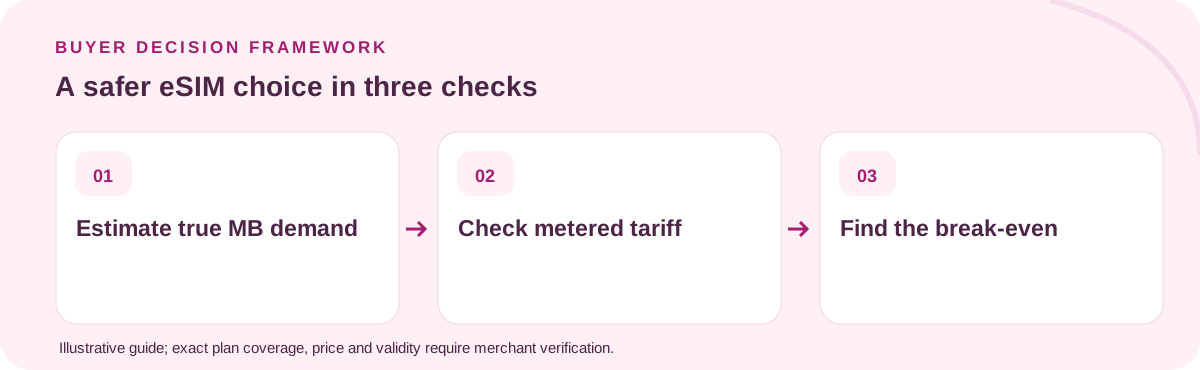
Find the actual roaming rate in the home-carrier tariff, including minimum billing increments and any automatic day pass. Estimate data in MB, not vague terms such as “light.” Compare the projected pay-as-you-go charge with a currently eligible prepaid offer including its purchase and activation conditions.
What to do before departure or purchase
Protect against background usage by checking phone update, photo backup, app refresh and automatic data-switching settings. A prepaid package often creates a clearer maximum allowance, but it should not be represented as unlimited spending protection if top-ups or other lines can incur charges.
Worked example with explicit assumptions
Illustrative math: 100 MB at $0.02/MB is $2, cheaper than a hypothetical $5 travel plan. At 600 MB the same rate is $12, so the eligible $5 offer would be less expensive. Neither rate nor price is a current merchant quote; the crossover depends on your actual tariff.
Common mistakes to avoid
One common mistake is using a daily voice/SMS roaming pass rate as if it also covered data. Another is assuming apps consume nothing in the background. The marginal cost of one extra MB can matter greatly under a metered carrier plan.
What would change the answer?
The break-even point is simply the prepaid final price divided by the actual price per MB, but the result is useful only if billing increments are considered. A carrier that rounds up to full MB units may charge differently from the raw traffic total. Always check whether an automatic daily roaming pass overrides the metered tariff once a threshold is reached.
Five-item decision worksheet
| Check | What to verify |
|---|---|
| Eligibility | Confirm the exact device, activation method and covered destination(s) against the retail product, not a country-average study. |
| Validity | Work backward from the situation described in this guide: A traveler spends two days in a neighboring country and uses only downloaded tickets and a few messages. Check when the clock starts and the last active day. |
| Usage | Estimate the full-speed GB or communication capabilities this particular itinerary needs; include hotspots, essential apps and an emergency buffer. |
| Economics | Compare current final payable totals only among options that meet every requirement; treat any arithmetic example here as hypothetical. |
| Fallback | Before departure, consider this failure mode: One common mistake is using a daily voice/SMS roaming pass rate as if it also covered data. Keep the seller’s support instructions available offline. |
Which option should you buy?
For a real weekend, measure or estimate the expected MB, read the actual pay-as-you-go conditions and compare eligible prepaid plans. The right answer may be “do not buy another eSIM,” especially if the home plan already covers the trip.
Is a prepaid eSIM always cheaper than metered roaming?
No. Very small data demand with a fair carrier rate may cost less. Compare the measured MB cost against the full eligible eSIM checkout price.
Primary technical/regulatory reference: official guidance for this topic. This source provides background, not a verification of any live TripoSIM SKU. The scenarios, prices and quantities in this guide are illustrations, not tested carrier offers. Every product's eligibility, data, voice, coverage, activation, fair use and current final price must be checked with the seller before purchase.
Ownership: This website is commercially affiliated with TripoSIM. It does not claim independent testing, neutrality or live catalog pricing. See research methodology.