

What should you do?
The winner is the cheapest eligible connection for your entire trip, including taxes, plan validity, data needs and likely top-ups.
Use the three-stage decision framework below, then confirm the exact purchasable TripoSIM plan at checkout. This website is owned by BroadNet and promotes TripoSIM; it is not an independent multi-provider marketplace.
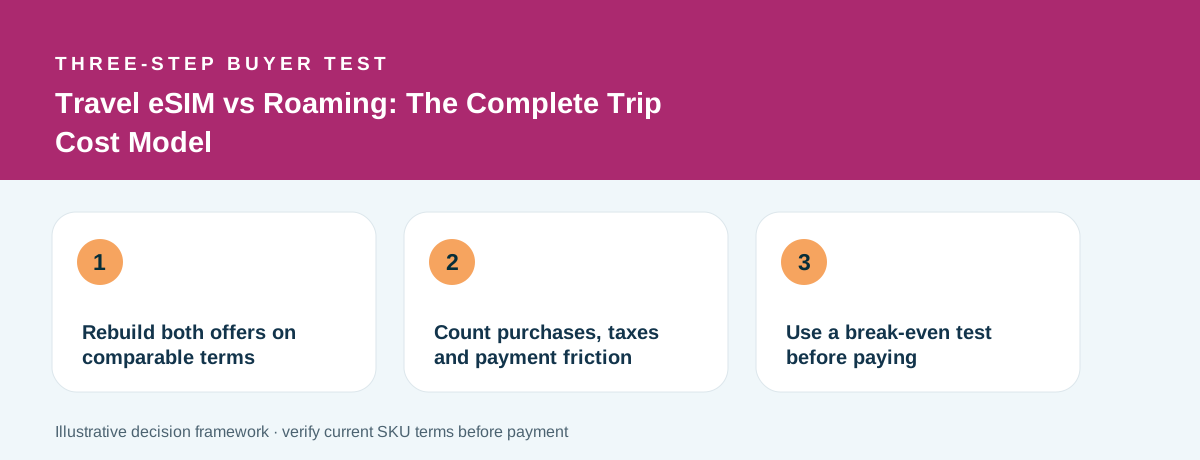
Rebuild both offers on comparable terms
A $7 eSIM and a $10-per-day roaming pass cannot be compared until you know which destinations, dates and data allowances each covers. Write down all expected travel days, the home carrier’s trigger for charging a roaming day, and the actual checkout amount for the eSIM. Compare them in the same billing currency.
Suppose a roaming pass costs $11 on each of eight charged days: the reference scenario is $88. A hypothetical eSIM cart of $28 plus a likely $12 top-up is $40. The modeled difference is $48, before checking validity, voice or SMS requirements and optional currency conversion fees. It is not a claim about any current offer.
If a home carrier already includes your countries with appropriate fair use, the incremental roaming cost may be zero. The correct comparison can legitimately favor the existing plan.
Count purchases, taxes and payment friction
For the eSIM side include the base price, local taxes if charged, payment processing, foreign currency conversion, and additional coverage or validity purchases. Some marketing discounts apply only to a specific SKU, customer segment, payment method or dates. Confirm the final cart, not a screenshot of an old promotion.
For the home carrier side distinguish a daily pass, a data bundle, a pay-as-you-go tariff and a capped roaming option. The fact that a carrier advertises a pass does not establish that it is the automatic billing outcome. Check the current customer contract and exact destination.
Avoid false precision. Use a clear “price checked at checkout on” timestamp if a current offer was actually verified; otherwise show a user-input model that does not disguise the calculation as live pricing.
Use a break-even test before paying
Compute the effective roaming cost over the expected charged days, then compare it with the all-in eSIM cost. If the values are close, factors such as support access, voice-call needs and the convenience of retaining the existing SIM may matter more than a small difference.
Example: at $9 per roaming day for six days, roaming totals $54. If a qualifying eSIM requires a $34 cart plus a $24 extra regional add-on, its all-in cost is $58. The headline $34 plan is not actually cheaper in this itinerary.
The calculator is only a decision aid. The merchant must confirm the exact SKU, destination coverage, installation requirements and refund rules before payment.
A decision you can use today
Choose a product only after you can answer the three questions above with evidence from its own listing. A useful outcome may be to keep your existing roaming plan, purchase a destination-specific eSIM, or choose a larger valid data allowance. The right answer depends on your actual itinerary and requirements.
Ready to compare current offers?
Use our existing buyer tools to work out your needs, then inspect the current TripoSIM plan details. Historical country observations are not final checkout prices.
Open the decision tools →View TripoSIM plans ↗Sources and editorial notes
Research method: source-specific technical guidance plus transparent arithmetic illustrations. None of the examples are independently measured customer usage, live supplier quotes or device tests. Reviewed 4 November 2026.